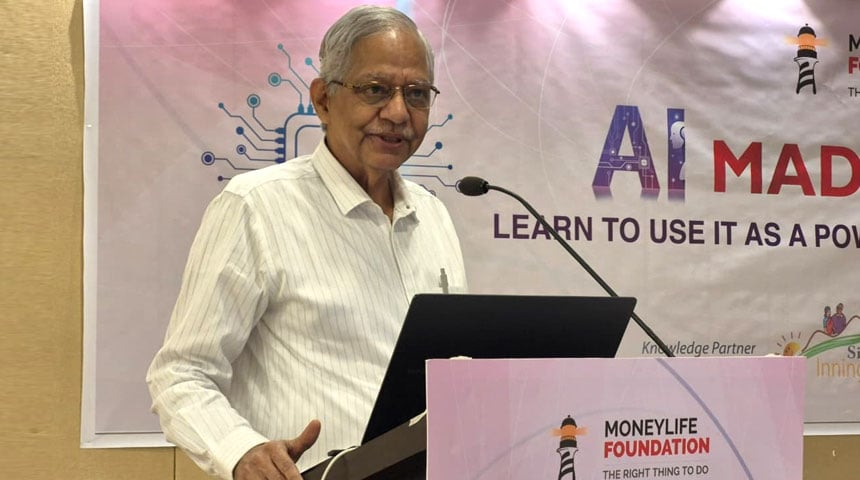
Technology educator Yazdi Tantra advised users to approach artificial intelligence with clarity, caution, and common sense, framing it as a powerful assistant that requires human oversight. Speaking at a workshop organized by the Moneylife Foundation, Tantra emphasized that AI should be used as a tool, not treated as a definitive source of truth.
The session, titled ‘AI Made Simple: Learn to Use It as a Powerful Productivity Tool’, was designed to make AI accessible for ordinary users, including senior citizens, journalists, and students. Tantra addressed the common intimidation many feel toward AI, noting that much of the anxiety stems from misinformation and a lack of practical guidance, even though most people already interact with AI daily without realizing it.
He pointed to familiar features like autocomplete on mobile phones, grammar suggestions in word processors, and automated spreadsheet projections as ubiquitous examples of AI integration. By grounding the concept in these everyday experiences, the workshop aimed to lower the barrier for users who feel they lack technical expertise.
AI in Plain Sight
Building on familiar examples, Tantra highlighted AI-powered features in common workplace applications. In video-conferencing platforms like Zoom, he explained how AI-generated meeting summaries allow late participants to catch up on key points without disrupting the session. Similarly, he detailed the increasing integration of AI within Gmail, where features like mail summaries, advanced Gemini search, and suggested replies can significantly reduce routine work.
The discussion extended to social media and messaging services, where AI assists with content suggestions and search. Tantra demonstrated how Grok, the chatbot integrated into X (formerly Twitter), enables users to seek conversational context on trending topics. He also noted the rise of AI-generated ‘quick read’ summaries on news websites, which help readers grasp key information quickly. However, he cautioned that these summaries should not replace reading full articles to understand necessary nuance and context.
The Art of the Right Question
Tantra addressed the concept of ‘prompt engineering’, dismissing the notion that it requires specialized technical skill. He argued that using AI effectively is more about asking clear, specific, and detailed questions.
“There are courses being offered on prompt engineering, which I find quite funny. All you really need to do is ask the right question.” — Yazdi Tantra
He compared interacting with an AI to visiting a doctor: just as a patient must describe symptoms accurately for a correct diagnosis, an AI user must provide sufficient context to receive a meaningful response. Vague prompts, he warned, inevitably lead to generic and less useful answers. He summarized AI’s primary functions into four categories: research, analysis, generation, and interaction. When used thoughtfully, these capabilities can boost efficiency but still demand human judgment for validation.
Applications, Tools, and Human Oversight
Clarifying a common misconception, Tantra stressed that AI models like ChatGPT do not invent facts but synthesize information already available on the web. This underscores the need for verification, as many tools provide source links for users to check.
“AI should be used as a starting point, not the final authority.” — Yazdi Tantra
He also warned against the risk of ‘AI hallucinations’ and uncritical reliance on AI-generated content. He urged participants to apply their own knowledge and cross-check information rather than accepting AI output as fact.
“You have to use your own brain at some point.” — Yazdi Tantra
The workshop covered a range of practical applications. In addition to generating text like articles and e-books, Tantra mentioned audio-to-text transcription services such as Otter.ai and Fireflies.ai, as well as text-to-audio tools for creating podcasts. He also touched on AI’s role in creating visual content, from presentations and illustrations to architectural concepts, without requiring formal artistic training.
Tantra described an emerging use case he called ‘experts in action’, where AI can be prompted to act as a legal assistant, financial planner, or travel agent to help structure thinking. He cited finance.perplexity.com for finance-related queries and platforms like Lex Machina and the Indian judicial initiative SUPACE for legal research. In all cases, he reiterated that these tools are aids and not substitutes for professional advice or human interpretation.
Finally, he pointed to aggregator platforms like AIfiesta.ai, which allow users to compare responses from multiple AI models side by side. Returning to his core message, Tantra concluded that the true skill in using AI lies not in mastering the technology itself, but in knowing when to question it, verify its output, and apply human reasoning.